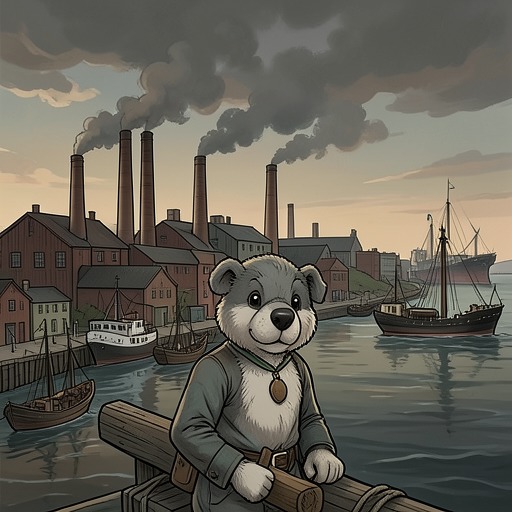
The world-historical impact of whaling
The WhaleWhaling emerges as a world-historical force because it joined the movement of ships and people to the conversion of whale bodies into wealth, energy, and industrial materials. The trade linked distant oceans to streets, factories, settlements, and wars; its consequences extended beyond the ports that profited from it. In the account, the sea remains a wilderness that human ambition repeatedly treats as a route and a storehouse, while the growth of that ambition leaves ecological losses that outlast the fortunes it created.
From the sea to the city
The material chain began with capture and continued through processing, manufacture, and consumption. On County Street in New Bedford, the wealth embodied in grand houses and gardens came, as the narrative emphasizes, from the Atlantic, Pacific, and Indian oceans. The contrast between those elaborate homes and the whales killed to finance them makes economic prosperity legible as an exchange between sea and shore: each decorative improvement had an animal cost. Whaling thus changed not only the waterfront but the built character and social fortunes of a port city.
On Nantucket, whale products entered a particularly intricate manufacturing process. Introduced to New England in 1748 by Jacob Rodriques Rivera, the candle-making technique turned sperm-whale headmatter into a clean-burning commodity. Workers heated it in large kettles to separate water and impurities, cooled the material in casks, and pressed it in woollen bags. The first pressing yielded the purest sperm oil, known as winter-strained. The remaining matter was stored as black cakes, re-pressed in spring, and then pressed a third time. The residue was clarified with wood shavings and potash into white wax. Each stage extracted a different value from the same material, turning a captured animal into products suited to a market for bright, reliable light.
The industry’s reach depended on ships carrying more than cargo. Whaling vessels opened routes into remote waters and helped connect distant settlements to commercial networks. The account describes whale-ships supplying convict settlements in Australia and bringing provisions to early settlers at Botany Bay during periods of scarcity. Samuel Enderby established an office in Port Jackson in 1791 and arranged for his vessels to carry convicts to New South Wales. The ships that pursued whales also moved people, equipment, and commercial influence; routes created for extraction became part of the infrastructure of settlement and imperial expansion.
Rivalry, mobility, and imperial reach
Whale oil was valuable enough to draw governments into the trade. During war with America, Britain offered bounties to ships supplying sperm oil. The competition was not simply between individual shipowners: British efforts to secure their own supply formed part of a broader attempt to extend influence into the southern hemisphere after the loss of the American colonies. John Adams, then the new republic’s ambassador, criticized the British preference for darkness over buying American oil, while the account sets his remark against the expanding confidence of the United States’ whaling industry. The trade made energy supply a measure of national power and a field of commercial rivalry.
Whaling also altered the direction of human movement. Whale-ships carried Irish people fleeing the Great Hunger to America, and the book links this wider migration to the author’s own family history. In this way, the industry’s influence reached beyond the transfer of goods: its vessels helped shape the journeys of populations and the relationships between distant regions. The account’s description of whaling as a peaceful influence is deliberately complicated by the movements it enabled, including colonial settlement and the extension of imperial authority. Maritime mobility could mean opportunity, escape, commercial expansion, or the consolidation of power, depending on who travelled and under what circumstances.
Energy, industry, and war
The fortunes of whaling changed as other sources of energy became available. Kerosene and coal gas began lighting streets and homes from the 1840s, and Edwin L. Drake’s 1859 oil well in Titusville, Pennsylvania, marked a decisive shift toward petroleum. The narrative presents the new oil economy not as an end to extraction but as a change in its object: the source of energy moved from the sea to the ground. Nantucket’s decline was also shaped by a silting harbour, the limits of access for larger ships, fire, migration, and war. In 1869 its last whaling ship departed, while the discovery of petroleum had already weakened the market that had sustained the trade.
The whale’s body continued to enter industrial production in new forms. In 1904, Norwegian and British steamships opened Antarctic grounds, where whale products were used to manufacture nitroglycerine. During the global conflicts, the same animals that had supplied industrial materials became part of wartime provisioning and production. The account estimates that 50,000 whales died during the two world wars and describes South Atlantic humpbacks as driven to extinction by 1918. The 1948 return of the factory ship Balaena to Southampton makes the scale of postwar processing tangible: its reported cargo included 4,500 tons of meat, 163,000 barrels of edible oil for margarine, 10,000 barrels of sperm oil, and meat extract and fodder. A single industrial voyage could supply several markets at once.
Factory ships intensified this conversion by bringing processing into the hunting grounds. In the Antarctic, blubber was reduced in steel boilers and stored in large tanks; one blue whale produced 133 barrels of oil and sixty tons of meat, valued at $28,000. The scale and efficiency of such operations exposed a stark contradiction: the ships represented technological organization and national supply, while their work depended on removing animals from distant waters faster than populations could recover. Industrial capacity turned the whale from a source of a few prized products into a comprehensive raw material.
Historical consequences and ecological limits
The expansion of capture did not proceed without consequences for whale populations. Sven Foyn’s patented grenade harpoon, praised in his diary as a providential invention, made fast rorquals such as blue and fin whales accessible to commercial hunters. As earlier targets had become too depleted or unprofitable, the new weapon and steam-powered pursuit extended extraction to species previously difficult to catch. The account presents this not as an isolated technological advance but as a recurring pattern: when one source of whale products diminished, new techniques and grounds made further populations available.
The effects reached beyond numbers. Research discussed in the book suggests that sperm-whale communities pass learned practices between generations and maintain distinctive social patterns. The removal of matriarchs could therefore also mean the loss of knowledge needed by their communities, while depletion of large males affected the animals’ breeding populations. The account places this social vulnerability beside the accelerating disappearance of species: during the writing of the book, the Yangtze River dolphin was declared extinct, and the author warns of further losses. These claims distinguish immediate commercial gain from slow ecological consequences that may become visible only after the industry has moved on.
The concept’s central tension is captured by the distance between the sea’s apparent permanence and the fragility of the lives within it. The ocean is described as ancient, vast, and still largely unknown; yet whaling repeatedly made its animals legible as oil, wax, food, or industrial feedstock. In tracing routes, manufacturing methods, migration, and wartime use alongside depletion, the account argues that whaling shaped world affairs precisely because its effects travelled so widely. Its history is therefore not only the history of a trade, but of how maritime power and industrial demand reorganized human societies while placing the sea’s living abundance at risk.